We are constantly expanding the range of services offered, taking care of children of all ages.

Get In Touch

KG2 (Montessori 3)

  • Home
  • KG2 (Montessori 3)

KG2 (Montessori 3)

Monday - Friday

9am – 3pm

Overview

For children aged 4.5 to 5.5 years, the Montessori environment—focuses on higher-order thinking, reading readiness, mathematical operations, and deeper cultural understanding. This stage is the peak of the first plane of development (0–6 years), where children begin to consciously absorb knowledge and show a natural interest in abstraction, logic, and social responsibility.

Curriculum Highlights

icon

Practical Life

(Mastery, Precision & Responsibility) At this stage, Practical Life evolves into complex sequencing and responsibility-based activities.

icon

Sensorial

(Abstraction and Naming) Sensorial work now helps children move toward abstract thinking and classification.

icon

Language

(Reading & Writing Development) This is a critical period for literacy. Montessori materials guide the child from phonetic awareness to fluent reading and expressive writing.

icon

Mathematics

(Foundation for Abstract Concepts) Math work becomes more structured, introducing operations and place value using hands-on materials.

icon

Cultural

(Geography, Botany, Zoology, History) The focus now is on naming, classifying, and understanding relationships in the real world.

icon

Art, Music & Movement

Now more refined and expressive with skill-building techniques.

Contact Now

Ready for study with us?

Have a question or concern? Share it with us through the form,
and our team will contact you shortly to provide the answers and support you need.
Enquire Now

Other Information

feature

Age

  • Age group 4.5 to 5.5 years
feature

Duration

  • 1 Year
feature
feature

Centers

  • All Centers
feature

Timings

  • 9AM to 3PM

Programs offered

Key Activities:

  1. Multi-step food prep (e.g., peeling, chopping, sandwich making)
  2. Washing cloths and hanging them to dry, folding clothes
  3. Arranging flowers
  4. Classroom chores (dusting, sweeping, setting up shelves)
  5. Leading grace & courtesy exercises

Advanced Materials:

  1. Binomial & Trinomial Cube (visual logic, early algebra)
  2. Geometry Cabinet with 3-part cards
  3. Constructive triangles (plane figures, relationships)
  4. Color Box 3 (grading many shades)
  5. Sound boxes (refining auditory memory)
  6. Smelling and tasting jars with vocabulary

Key Activities:

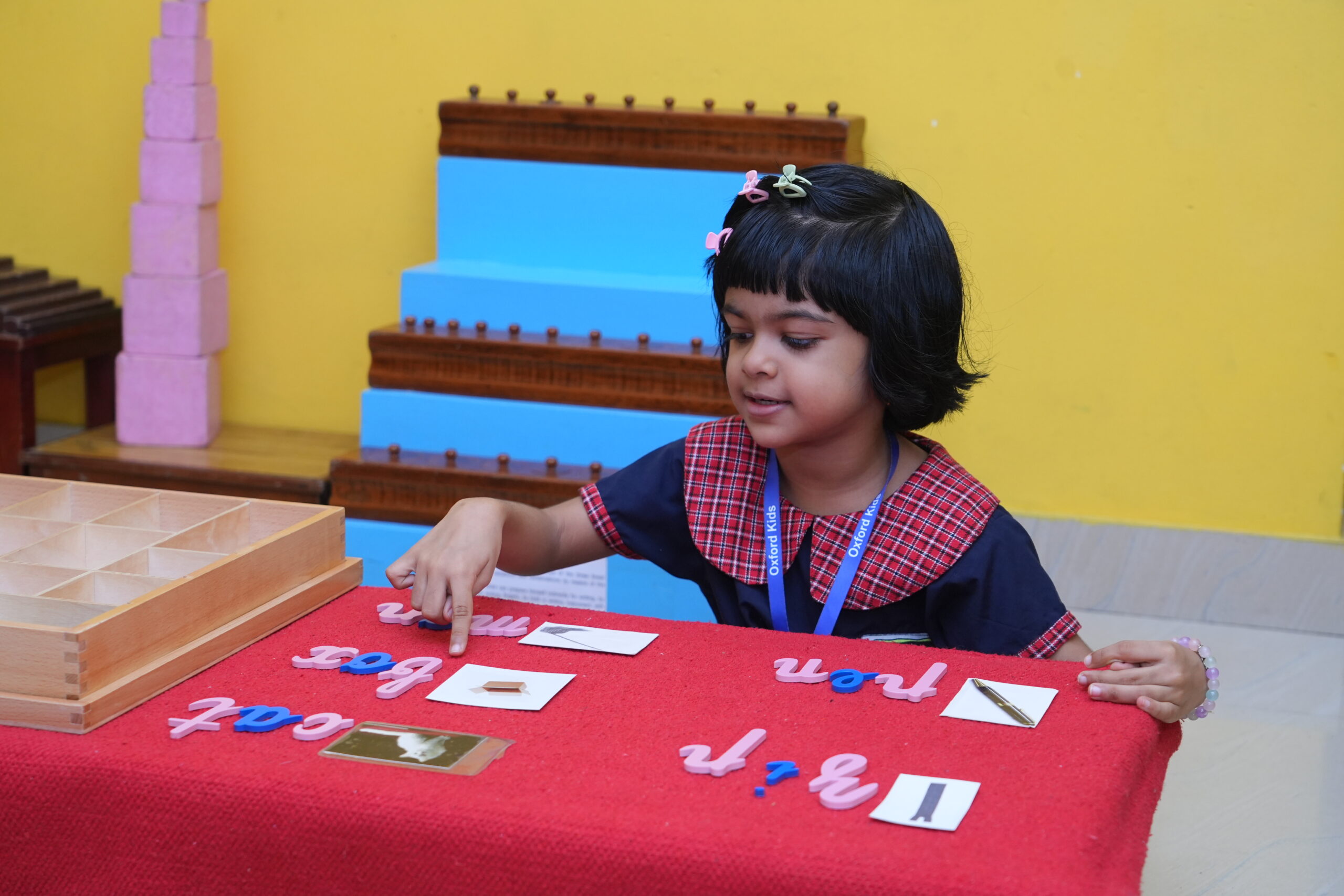
  1. Moveable alphabet: building phonetic and phonogram-based words
  2. Reading 3-letter and 4-letter phonetic words
  3. Word building with blends and digraphs (ch, sh, th)
  4. Matching objects to labels (reading practice)
  5. Puzzle words (sight words)
  6. Sentence building (using color-coded cards)
  7. Metal insets for writing control
  8. Creative story writing and journaling (using picture prompts)
  9. Book-making (children make their own books)

Key Activities:

  1. Golden bead work: units, tens, hundreds, thousands
  2. Static and dynamic addition & subtraction (with golden beads)
  3. Stamp game (transition to abstraction)
  4. Seguin Boards A & B (teen and tens numbers)
  5. Introduction to multiplication and division (grouping & sharing with materials)
  6. Bead stair (1–9) and number bonds
  7. Snake game (addition practice)
  8. Introduction to memorization of facts (addition tables)

Geography:

  1. Puzzle maps of continents and countries
  2. Land & water forms (names, models, definitions)
  3. Flags and continent folders
  4. Study of people, clothing, food, and festivals
  5. Botany & Zoology:
  6. Parts of the leaf, flower, root, tree, fish, bird, etc.
  7. Classification charts (vertebrates/invertebrates, monocot/dicot)
  8. Simple experiments (photosynthesis, water absorption)
  9. Life cycles (frog, butterfly, plant)

History:

  1. Timeline of the child’s life
  2. Seasons, months, days of the week
  3. Personal timelines and family trees

Art:

  1. Pattern making, coloring within shapes
  2. Origami and craft projects
  3. Watercolor and brush techniques
  4. Clay modeling (with theme-based prompts)
  5. Music & Movement:
  6. Dance and drama (theme-based role plays)
  7. Yoga and movement games
  8. Key Characteristics of This Stage:
  9. Child seeks mental challenge and loves purposeful work
  10. Increased collaboration and peer interaction
  11. Beginning of moral sense and fairness
  12. Preparing the child for the next level of abstraction (6+ years)

Watch on YouTube

Youtube